Showing posts with label desert. Show all posts

Thursday, December 23, 2010

The Magical North: La Serena/Valle de Elqui


Day 1:
-We took the bus up to La Serena, about a 6 hour ride along a beautiful blue coastline and rugged rolling hills
-La Serena itself is an odd sort of city, sort of a conglomerate between old historical arquitecture and a relatively new sprawling boom in beach homes
-We had a relaxing time on the horseshoe shaped beach, flanked at one end by a large cross on a hillside, even venturing into the water a bit, playing “futbol” and taking walks past gigantic mounds of shells
-Our delicious dinner of pastel de papas, a casserole with mashed potatoes and meat featured a delicious local specialty for dessert, papaya tinged ice cream!

Day 2:
-We started the day off with a visit to a colorful church and cemetary
-To get to our destination of Valle de Elqui, we drove through the desert, the bleakness of which was offset in places by the artificiality of brilliant patches of green agricultural fields. Because there is sun year round, it makes a perfect place to grow grapes. Minus one thing: water. Combined with increased agricultural pressures and climate change, the pressures for water in this region are increasing, as supply falls. We saw one consequence of this, an albeit beautiful dam that covered what previously had been fields for growing. Although it generates a little bit of electricity, it’s main purpose is for irrigation.

We traveled on through the valley to the town of Pisco Elqui, home to the tourism center of Pisco Mistral, one of the higher end makers of pisco in Chile. Pisco, practically the national drink of choice, is essentially wine that is processed down, making a stronger alcohol. We had a tour of the process and got to try some pisco, although it was by our judgement a little too strong to taste test without some sort of a mixer. After a wonderful lunch, we headed back a ways to visit the grave of nobel laureate Gabriela Mistral, who sadly, while extremely popular in Chile, is largely unknown outside her homeland. (Likely) A lesbian schoolteacher and later stateswoman, she lived much of her life in poverty and obscurity, which is somewhat reflected in her poetry. However, she was also a woman of very strong faith, and many of her writings reflect a religious element. Some of her most well known poetry is for children: as a schoolteacher, she wrote many songs to teach Christian themes.

After a ride back through the valley, we arrived at our beautiful hotel in the town of Vicuña, where we relaxed from the heat for a bit next to the gorgeously landscaped pool. After a gracious afternoon and a lovely dinner, we headed out to an observatory up in the mountains for some stargazing. This area of Chile, due to the relative lack of light pollution and the extreme dryness, is home to many of the world’s scientific observatories.

Unfortunately, due to the light thrown by the incredibly full moon, the stars were not quite as clear as they had been when I was further North in San Pedro, but they were still phenomenal. With the aid of a telescope, we were able to see a close up on the moon, the Pleiades, a nebula and planets, including Jupiter and some of its moons. It was a magical night.

Day 3:
We started our last day with a trip to Gabriela Mistral’s house and museum, which I really liked, because it gave me several perspectives on her life that I had not previously known about. She had a beautiful quote in one of her books that falling in love with a country was something akin to marriage, which really summed up how I felt about Chile at the time. I’ll have to find it at some point and share it with you all...

For something completely different, we stopped by a solar restaurant! Using mirrors and special boxes, this restaurant only uses heat from the sun to cook all their food, which is tremendously tasty because of the slow way it is cooked.

We made our way back towards Santiago, but not without one more stop: in the beach town of Guanaqueros, a beach town with beautifully colored ocean on one side and desert on the other. We had a nice lunch of shrimp empanadas and fish before heading back for a long ride home.

Sunday, August 15, 2010

August 7: Unidad


Words of the Day: Portuguese Edition!
Exquisito= awkward, strange, weird (unlike Spanish where it means really good)
Quente= hot (temperature)
embarazada= embarassed (unlike Spanish where it means pregnant)

Today started out less than propitiously, but wound up being phenomenal due to several interesting turns of events.

Despite waking up with more than adequate time for the tour to Las Lagunas Altiplanicas that I had bought a ticket for, due to miscommunications, I missed it. Apparently, they were going to pick me up at the Hostel but I had gone to their office. An hour of frantic phone calls and running around later, it was clear that $40 was down the drain. While the Yankee thrift part of me was weeping at the waste, the adventurous side kept whispering "APROVECHAR". I knew I couldn't just sit around moping and had to do something to use the only full day I would have to the max.

The problem was that my traveling companion was off sandboarding for the day, leaving me alone. Plus, all the morning tours had left. But in a stroke of fabulous luck, while strolling by the tour agencies to look for options I ran into a group of 3 French girls I had met on the Valle de Luna tour the day before. They were going biking nearby and invited me to join them.

Turned out to be my favorite part of the trip. As the ultimate self-hating tourist, the person who wants to see everything but also be away from the hordes, being self propelled for a morning was wonderful. While there were plenty of other people on the path, it certainly wasn't an excessive number and the sight of desolate reddish cliffs, grassy valleys (with tufts as tall as me) and icy mountain streams which we frequently had to ford lent a feeling of adventure.

The man we rented the bikes from recommended heading out to Grito del Diablo also known as Quebrado de Chulaco, a canyon with a zig-zag formation. When we finally got up to the Canyon mouth, the girls wanted to have lunch. Given the lack of planning that had gone into my morning, I had planned on eating when I got back. So, leaving my bike with them for safe keeping, I decided to go in and explore the canyon on foot.

Best decision of the trip. Oddly enough, no one else was there. It was the most alone I have ever been in my life yet never have I had an experience that made me feel so ALIVE! The silence of the place was deafening, but made me realize how incredibly noisy I was: my footsteps, the slosh of my waterbottle, the click of my camera and even at my stillest, the loudness of every breath.

Being there around the seemingly infinite rocks made me think of Pablo Neruda's "Residence on Earth," a collection of poetry that my Spanish teacher had introduced us to last semester. Essentially, through, Neruda introduces a philosophy that the only way to find happiness and peace is through accepting the circular nature of things and their subordination to time. There is a unity in all things, he argues, something that everything has in common but yet is often obscured by humanity's frequent inability to get over ourselves. For me, it was impossible to deny the existence of unidad in such a place. Seeing my weakness and smallness compared to the vast cycling of the landscape was oddly comforting for something that I usually find frightening or at the very least as a stress inducing challenge to go get things done. Instead, I was left with a feeling of incredible thankfulness: I realized how much my life has been blessed with beautiful and incredible moments and people. Until then, I honestly think I had taken this study abroad opportunity for granted, rather than seeing it as something for which I am incredibly privileged. Here I am, at barely 20 years old, half way across a hemisphere and being witness to such amazing things.

After joining up with the group and biking through the canyon a second time, we decided, since we had a little time left, to bike uphill to "El Tunel," a mirador from which the whole valley could be seen. Although the ride was strenuous, especially with the little altitude boost, it was tremendous.

Bidding goodbye to the girls, I found an albahaca empanada (cheese, tomatoes, herbs= closest thing in Chile to NY style pizza flavor) for lunch and a tour to the Salar de Atacama, a salt flat with lakes, for the afternoon.

Our tour group was great: we were mainly young Spanish or Portguese speakers, so the guide spoken in Spanish the whole time. We visited:
-Laguna Cejar- three times saltier than the ocean so you can float. That is, if you can stand the cold. Gorgeous, but I only braved the water for about 1 minute.
-Ojos de Salar- perfectly circular deep fresh water pools side by side- one green, the other blue. Swimmable, although I passed...
-Laguna Tebenique- My favorite! Shallow, big lake where we watched the sunset.

While we snacked and watched the sun go down, we had an interesting conversation about the differences between Portuguese and Spanish, travel and Iberian colonial legacies. We were the last tour group to leave, which meant that the stars were coming out as we returned. By 7:30, the sky was literally filled, all the way down to the horizon, including the Milky Way visible from one side to the other. Across the flat, the lights of tiny pueblos glistened and blinked happily. Certainly one of the best all time van rides of my life.

Thursday, August 12, 2010

August 6: "See that the rocks have touched time"


Word of the day:
animita: small roadside shrine to loved ones

We arrived in San Pedro a little before noon. The town was so unexpected because there is literally nothing on the road up to it, save a few animitas that grew increasingly ominous as the bus slowed down considerably or rounded twisting curves.

San Pedro has an incredibly unique smell: the dust, clay and lack of moisture are palpable. The town itself, or at least the touristy parts of it, are constructed from adobe that has been whitewashed, giving it a unique look as well. There's a small central plaza, a church, several blocs of tour agencies, restaurants etc. and a large cemetary.

The majority of the 4000 residents however, live in less than ideal conditions, some which could even be described as shameful. Rudely constructed from cardboard, wood scraps and corrugated metal, many of these houses seemed even more precarious than some of those in the worst areas of Santiago.

We were picked up Roberto, the owner of the hostel where were were staying in his ancient turquoise truck. With long black hair, even longer than mine, he seemed exactly like a character from an Southwestern movie. The hostel itself was perfect for what we need, comfortable beds, bathrooms, a kitchen and hammocks constructed around a central common area. Roberto×s family lived in part of the compound, including presumably his mother and father, an old man with no hands. The whole relaxed atmosphere of the place and the different cast of characters from upper middle class Santiago made it seem worlds away.

With no time to lose, we headed back to the centro to look for a tour for the evening. We decided it would best to check out Valle de la Luna (¨Moon Valley") for a tour that lasted until the sunset.

Our tour started out from a mirador overlooking the whole valley and checking out the mountains, which the ancient Atacamenian people viewed as gods and goddesses.

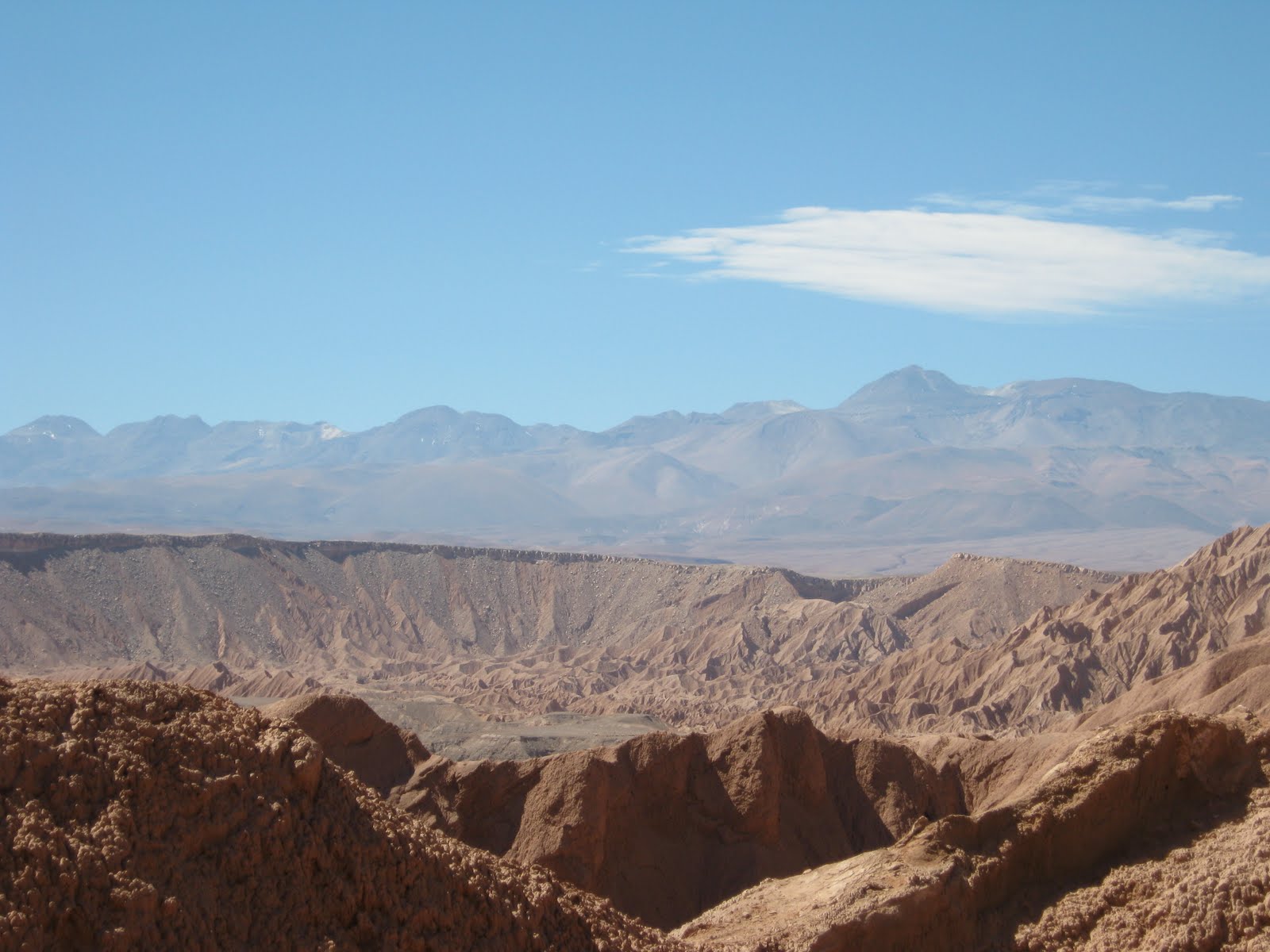
From there, we went to check out Valle de la Muerte, so named because it is so arid and saline that no life can exist there OR because a Belgian priest tried to name it "Mars Valley" but was misunderstood because of his accent.

Interfacing with the desert was such a different experience than interfacing with a new city, the only kind of exploration Ive done in a while. While cities are such a celebration of all that it means to be human, the deserts presence signifies your utter negation.

From there, we went on to Valle de la Luna, so named because its strange surfaces look like the moon from above. It was really quite stunning, especially as we got to hear the crackling of salt and mica layers contracting as the sun set which sounded almost like raindrops falling.

Finally, to watch the sun's final plunge, we climbed the Big Dune. Although there was a gigantic crowd of people, it was still a very intimate moment with nature. We sat quietly, humbled as the sun's descent painted a panorama of colors across the mountains and rocks, leaving purples, reds, yellows and blues so strong it appeared as if there were lakes. Quite simply put, it was phenomenal.

Wednesday, August 4, 2010

August 4: "Wilderness is not a luxury but a necessity of the human spirit"

Actually, I'm pretty sure Edward Abbey() would heartily disapprove of this long weekend's vacation plans. I'm going to San Pedro de Atacama, which I've heard is somewhat touristy, to visit the Atacama Desert, which hopefully is still blooming thanks to excessive rainfall this winter and has a zillion other things to see. I've wanted to go to the desert for a long time, especially after reading "Desert Solitaire" last summer, so I figured a quote was appropriate, even if Abbey would hate the tourism industry that has built up around the last few beautiful places.

I'm intrigued by the thought of seeing something so vast. I love Santiago, but it has taken a toll on my senses, especially since I've been running all over the city by foot, bus and metro to check out classes and other doings.Furthermore, there's really no better time to escape the city's commercialism. "El Día del Ñiño" (Day of the Child) is tomorrow, a holiday that is the equivalent of an even more commercialized Mother's Day. Meaning that everything is abuzz with buying and selling. Since I've checked out all the classes I need to visit until next week, there's no better time for me to get away from the "hole" of Santiago (This is how the city was described to us by a famous professor who gave a lecture during orientation). After being here for nearly a month, with so many things to contemplate on, I feel that going to visit something that utterly dwarfs myself is in order.