I'm almost glad I got sick on the last day, because it made it so much easier to leave. There were still so many things that I wanted to do that I didn't have the time, money or language skills to undertake. I wanted to talk more with Roberto (the hostel owner) and his family to better understand their lives. I'm so curious how they view the hourdes of tourists that come into San Pedro. There were still so many places I hadn't explored and since every second of the day looks different in the desert, I wouldn't have minded simply sitting in one spot for a long long while. But the most nagging thing that tempted me to stay was the urge to explore the reasons behind the overall poverty of the place, beneath its slick veneer. How can poverty exist in a place with obvious economic stimulus, $40 tours and restaurants at double Santiago prices? What I suppose is that it has a lot to do with lack of resources, education, discrimination against darker skinned people of Peruvian/indigenous descent (although I might be misapplying a US inspired race lens to the situation) and possibly even exploitation.
This trip (along with experiences from several others) has made me aware of how passionate I am about issues surrounding housing. The experiences I've had in the last year whether seeing the often brutal complexities of the US public housing system with LIFT, being in homes in rural Guatemala and now seeing the extreme variation in quality in Chilean homes has convinced me of the centrality of this issue in bettering peoples lives. Of course, these experiences have also made me extremely grateful for the incredible stability of my home life over the years I spent in my creaky, quirky, 18th century farmhouse. I'm very glad to announce that I will be most likely working on an internship with a Chilean NGO known as Un Techo para Chile (One Roof for Chile), which essentially works to better inadequate housing conditions. While I won't be working directly with housing issues but rather their effects, such as lack of access to education, I think it's going to be a great fit.
Showing posts with label san pedro. Show all posts
Showing posts with label san pedro. Show all posts
Tuesday, August 17, 2010

Sunday, August 15, 2010
August 8: Highs and Lows


We woke up at 3:30 am in order to be ready for the Geyser Tour that left at 4. Oy.
Things went well for the first hour of the ride: excellent stargazing kept me occupied. Things got dicey in the second hour when our van, in which I was seated in the back with a strong smell of exhaust, started going on roads that were unpaved and generally not very roadlike. We had also neglected to take altitude into account: we were 4km up in the mountains, not 4000m. Yikes.
Altitude sickness or car sickness or something caught hold of me. Before we even arrived, my weak stomach had had enough, warranting a pull over to the side of the road which attracted everyone's attention and led to a parade of remedies. Oxygen, two types of pills, another round of vomiting, a random healing treatment by a women who was convinced her energy would help me, coca leaves and a strange herbal tea later, I finally felt well enough to make it through the ride back.
Although I had had some reservations about them, the geysers really were phenomenal. While I was expecting 10 or so, there were at least a 100 and probably more.
I wish I could have enjoyed the experience more, but now I know to be better prepared when it comes to dealing with altitude and poor roads. The mountain views were great as well and there was lots of wildlife, such as vicuñas, adorable llama cousins.
The ride home was one of my favorite moments on the trip as well. After passing through Guatin, a valley filled with cactus, we descended with the purple of the Andes on one side and the Salar de Atacama on the other. Simply gorgeous. As we drove in through a particularly poor section of the town that I had never noticed before even though we were staying nearby, Victor Jara's "Las Casitas del Barrio Alto" (Essentially the same song as the Weeds intro for any fans) played out on the radio. It was a moment shot through with eye opening irony, the perfect way to end a self absorbed uncomfortable morning.
August 7: Unidad



Words of the Day: Portuguese Edition!
Exquisito= awkward, strange, weird (unlike Spanish where it means really good)
Quente= hot (temperature)
embarazada= embarassed (unlike Spanish where it means pregnant)
Today started out less than propitiously, but wound up being phenomenal due to several interesting turns of events.
Despite waking up with more than adequate time for the tour to Las Lagunas Altiplanicas that I had bought a ticket for, due to miscommunications, I missed it. Apparently, they were going to pick me up at the Hostel but I had gone to their office. An hour of frantic phone calls and running around later, it was clear that $40 was down the drain. While the Yankee thrift part of me was weeping at the waste, the adventurous side kept whispering "APROVECHAR". I knew I couldn't just sit around moping and had to do something to use the only full day I would have to the max.
The problem was that my traveling companion was off sandboarding for the day, leaving me alone. Plus, all the morning tours had left. But in a stroke of fabulous luck, while strolling by the tour agencies to look for options I ran into a group of 3 French girls I had met on the Valle de Luna tour the day before. They were going biking nearby and invited me to join them.
Turned out to be my favorite part of the trip. As the ultimate self-hating tourist, the person who wants to see everything but also be away from the hordes, being self propelled for a morning was wonderful. While there were plenty of other people on the path, it certainly wasn't an excessive number and the sight of desolate reddish cliffs, grassy valleys (with tufts as tall as me) and icy mountain streams which we frequently had to ford lent a feeling of adventure.
The man we rented the bikes from recommended heading out to Grito del Diablo also known as Quebrado de Chulaco, a canyon with a zig-zag formation. When we finally got up to the Canyon mouth, the girls wanted to have lunch. Given the lack of planning that had gone into my morning, I had planned on eating when I got back. So, leaving my bike with them for safe keeping, I decided to go in and explore the canyon on foot.
Best decision of the trip. Oddly enough, no one else was there. It was the most alone I have ever been in my life yet never have I had an experience that made me feel so ALIVE! The silence of the place was deafening, but made me realize how incredibly noisy I was: my footsteps, the slosh of my waterbottle, the click of my camera and even at my stillest, the loudness of every breath.
Being there around the seemingly infinite rocks made me think of Pablo Neruda's "Residence on Earth," a collection of poetry that my Spanish teacher had introduced us to last semester. Essentially, through, Neruda introduces a philosophy that the only way to find happiness and peace is through accepting the circular nature of things and their subordination to time. There is a unity in all things, he argues, something that everything has in common but yet is often obscured by humanity's frequent inability to get over ourselves. For me, it was impossible to deny the existence of unidad in such a place. Seeing my weakness and smallness compared to the vast cycling of the landscape was oddly comforting for something that I usually find frightening or at the very least as a stress inducing challenge to go get things done. Instead, I was left with a feeling of incredible thankfulness: I realized how much my life has been blessed with beautiful and incredible moments and people. Until then, I honestly think I had taken this study abroad opportunity for granted, rather than seeing it as something for which I am incredibly privileged. Here I am, at barely 20 years old, half way across a hemisphere and being witness to such amazing things.
After joining up with the group and biking through the canyon a second time, we decided, since we had a little time left, to bike uphill to "El Tunel," a mirador from which the whole valley could be seen. Although the ride was strenuous, especially with the little altitude boost, it was tremendous.
Bidding goodbye to the girls, I found an albahaca empanada (cheese, tomatoes, herbs= closest thing in Chile to NY style pizza flavor) for lunch and a tour to the Salar de Atacama, a salt flat with lakes, for the afternoon.
Our tour group was great: we were mainly young Spanish or Portguese speakers, so the guide spoken in Spanish the whole time. We visited:
-Laguna Cejar- three times saltier than the ocean so you can float. That is, if you can stand the cold. Gorgeous, but I only braved the water for about 1 minute.
-Ojos de Salar- perfectly circular deep fresh water pools side by side- one green, the other blue. Swimmable, although I passed...
-Laguna Tebenique- My favorite! Shallow, big lake where we watched the sunset.
While we snacked and watched the sun go down, we had an interesting conversation about the differences between Portuguese and Spanish, travel and Iberian colonial legacies. We were the last tour group to leave, which meant that the stars were coming out as we returned. By 7:30, the sky was literally filled, all the way down to the horizon, including the Milky Way visible from one side to the other. Across the flat, the lights of tiny pueblos glistened and blinked happily. Certainly one of the best all time van rides of my life.
Thursday, August 12, 2010
August 6: "See that the rocks have touched time"


Word of the day:
animita: small roadside shrine to loved ones
We arrived in San Pedro a little before noon. The town was so unexpected because there is literally nothing on the road up to it, save a few animitas that grew increasingly ominous as the bus slowed down considerably or rounded twisting curves.
San Pedro has an incredibly unique smell: the dust, clay and lack of moisture are palpable. The town itself, or at least the touristy parts of it, are constructed from adobe that has been whitewashed, giving it a unique look as well. There's a small central plaza, a church, several blocs of tour agencies, restaurants etc. and a large cemetary.
The majority of the 4000 residents however, live in less than ideal conditions, some which could even be described as shameful. Rudely constructed from cardboard, wood scraps and corrugated metal, many of these houses seemed even more precarious than some of those in the worst areas of Santiago.
We were picked up Roberto, the owner of the hostel where were were staying in his ancient turquoise truck. With long black hair, even longer than mine, he seemed exactly like a character from an Southwestern movie. The hostel itself was perfect for what we need, comfortable beds, bathrooms, a kitchen and hammocks constructed around a central common area. Roberto×s family lived in part of the compound, including presumably his mother and father, an old man with no hands. The whole relaxed atmosphere of the place and the different cast of characters from upper middle class Santiago made it seem worlds away.
With no time to lose, we headed back to the centro to look for a tour for the evening. We decided it would best to check out Valle de la Luna (¨Moon Valley") for a tour that lasted until the sunset.
Our tour started out from a mirador overlooking the whole valley and checking out the mountains, which the ancient Atacamenian people viewed as gods and goddesses.
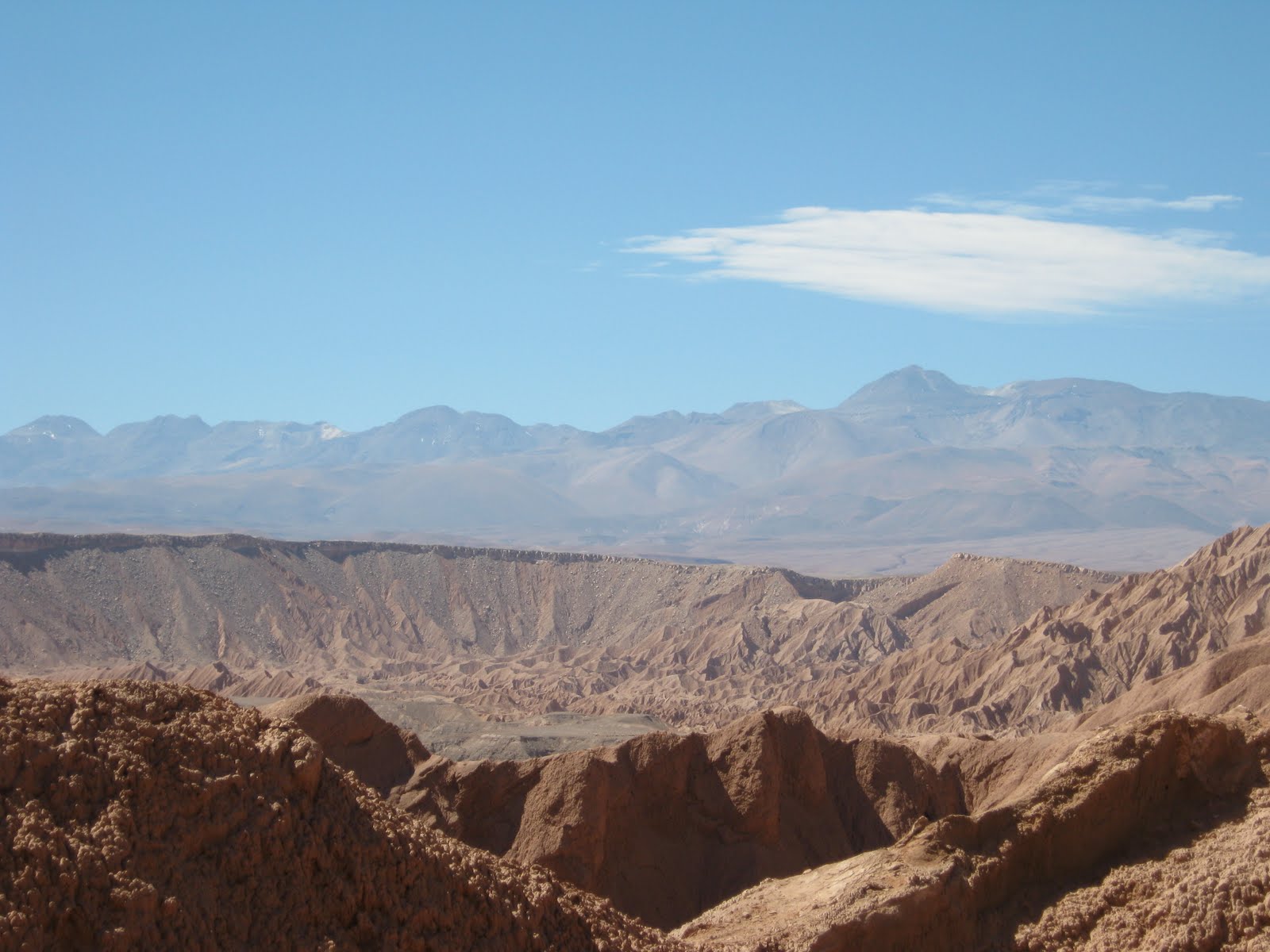
From there, we went to check out Valle de la Muerte, so named because it is so arid and saline that no life can exist there OR because a Belgian priest tried to name it "Mars Valley" but was misunderstood because of his accent.
Interfacing with the desert was such a different experience than interfacing with a new city, the only kind of exploration Ive done in a while. While cities are such a celebration of all that it means to be human, the deserts presence signifies your utter negation.
From there, we went on to Valle de la Luna, so named because its strange surfaces look like the moon from above. It was really quite stunning, especially as we got to hear the crackling of salt and mica layers contracting as the sun set which sounded almost like raindrops falling.
Finally, to watch the sun's final plunge, we climbed the Big Dune. Although there was a gigantic crowd of people, it was still a very intimate moment with nature. We sat quietly, humbled as the sun's descent painted a panorama of colors across the mountains and rocks, leaving purples, reds, yellows and blues so strong it appeared as if there were lakes. Quite simply put, it was phenomenal.
Subscribe to:
Posts (Atom)